by William C. Leikam
President, CEO & Co-founder, Urban Wildlife Research Project
What’s All This Chatter About Scat?
Part 2
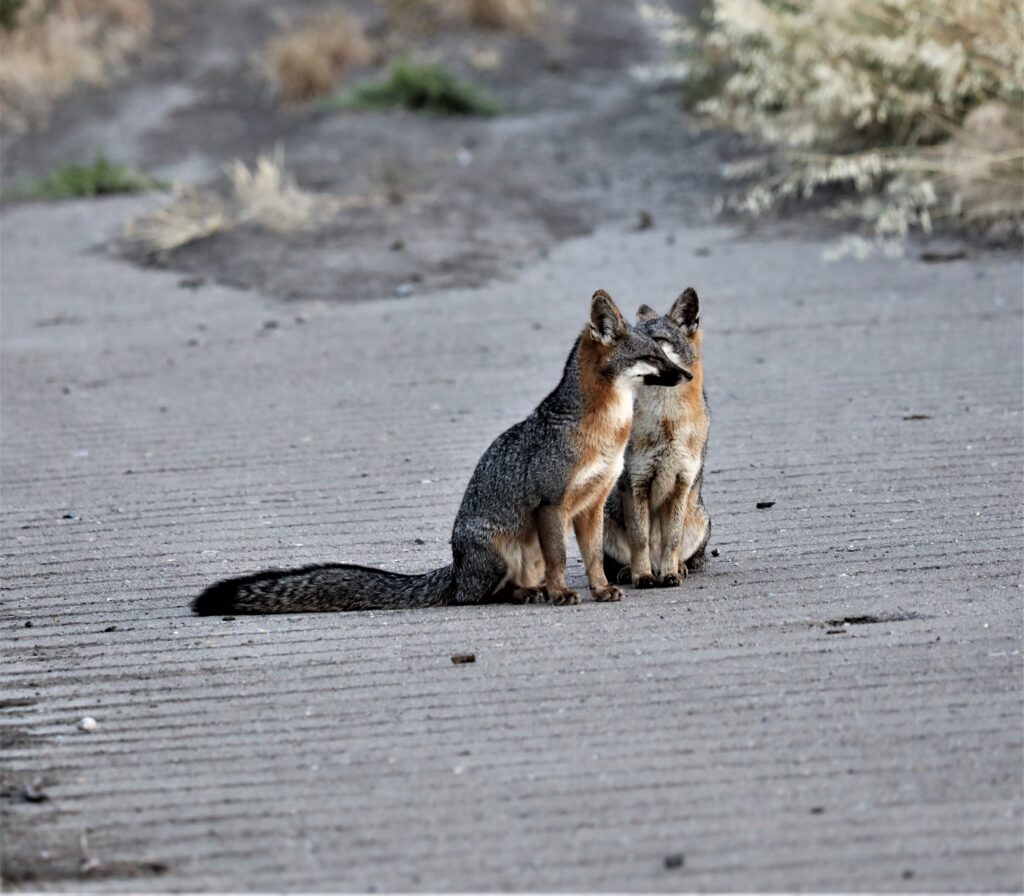
In Part 1 of this series on the importance of scat, I pointed out that your dog is also involved in this issue of scat; mainly urine because most people pick up their dog’s feces, but in the wild, both feces and urine are purposefully used. Here we go deeper into the relevance and uses of it. In years past, out in the territory that I’m monitoring there were both red foxes and gray foxes vying for the same territory. Foxes use scat to demarcate territory and their home range. But now, what happens when there is a trespasser coming in on territory claimed by the gray fox pair Laimos and his mate Big Eyes? They had seriously marked their area and one of the most prominent areas was right near the top of a ramp that leads into the concrete overflow channel.
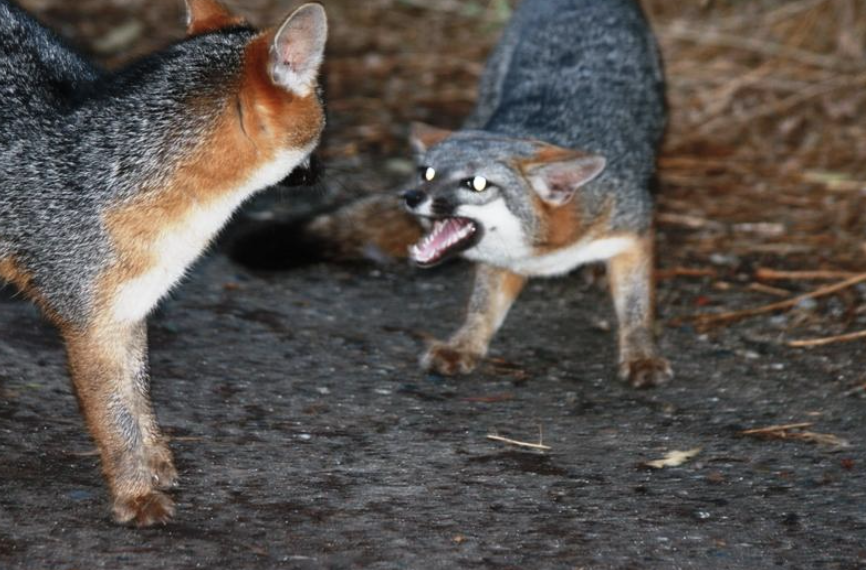
Two years ago, I posted a trail camera there on a tree at the top of the ramp. The gray fox pair Laimos and Big Eyes had, three years earlier claimed that region. Laimos defecated there near the ramp’s top to let any other fox that the territory was theirs. Several months later, a red fox pair came trotting into the territory and when they came to the place where Laimos had marked, one of them sniffed, turned, and defecated on top of Laimos’ scat. The following night, Laimos came by that same area, sniffed, and undoubtedly knew that another fox had been there and had marked. Laimos marked on top of the red fox scat. Sometimes the two foxes urinated on the spot, and on and on it went, night after night for about a month. In essence the red foxes announced, “This is our territory, now. By this scat mark, we claim it as our own.” And Laimos’ scat-response might be, “This territory belongs to Big Eyes and Laimos. We arrived first. We marked our territory, so get out.” The scat wars continued until, maybe the red foxes got the word, because they vanished. Once they had left, Laimos and Big Eyes abandoned the “war zone.”
The following is not a part of my own observations, but instead taken from a scientific paper titled “The scent of your enemy is my friend? The acquisition of large carnivore scent by a smaller carnivore” (Maximilian L. Allen 1,2 • Micaela S. Gunther 3 • Christopher C. Wilmers 1).
Gray foxes are smart and they easily learn to adapt to their region, even when within that region there are puma, and coyotes, both of whom prey on gray foxes. In the Santa Cruz Mountains nearby, Chris Wilmers has been studying the California Puma for many years now. He uses trail cameras to capture the activity among a variety of wildlife. When pumas mark their territory, they use the scent glands on the bottom of their paws to announce that they had passed this way. It’s called a scrape, marking the area, letting other wildlife in the area to be aware that puma are around.
Enter the gray fox. It will sniff around in a scrape and then using its scent glands on its cheeks, the gray fox wallows in the scrape and by so doing, the fox picks up the scent of the puma. (http://www.momo-p.com/showdetail-e.php?movieid=momo160812uc01a) With that scent in their neck fur, not only does it cover up the gray fox’s native scent, but coyotes and other predators will avoid them. The gray fox has just tricked the local predators like the coyote into thinking that a puma is around, and therefore they avoid contact.
Until next month, take care of your environment and the critters that live therein.
What's Happening at UWRP?
Alie Ward’s podcast Ologies can be accessed on any of the podcast “stations” online such as Apple, Spotify iHeart, Podbay, or here at her website https://www.alieward.com/ologies/urocynology. If you chose the website, scroll down the page to find out more. In the very beginning there is a short advertisement before she and I get into the fray of it all. Enjoy.
If you thought it worthwhile, please, spread the word through your personal networks.
Read the latest about Bill in this new article posted on Palo Alto Online: Experts push for creek naturalization after rare beaver died in Palo Alto
If you or your organization would like to have Bill aka the Fox Guy present one of his four PowerPoint presentations:
1. A Year with the Urban Gray Fox – MOST POPULAR
2. Human Development, Sixth Mass Extinction & Gray Foxes – An historical look at how we got to our present place in history.
3. Gray Fox Cognition – What & How Gray Foxes Perceive – This is a speculative attempt to get inside the mind of a gray fox
4. Corridors & Connections – Sustaining the Health of Our Wildlife – The title says it all
Contact us here https://urbanwildliferesearchproject.org/contact/ and let us know that you would like to have the Fox Guy give a presentation to your organization, corporation, or a home visit.
On June 14, Bill gave a short presentation in the Elephant Room at Safari West, at 8:00 PM. We had a full house and, in the Q, & A segment several interesting questions were asked including, “In the community of gray foxes, do you think there are any LGBTQ foxes?” I replied, “Yes. Science has shown that there are such individuals in many mammal communities. In the fox community, there are some that never pair up with a mate of the opposite sex.”
Videos and Documentaries

My journey to the University of Zurich, Switzerland, Triggered By Motion
Bill’s book The Road to Fox Hollow can be purchased directly from Bill for a mere $20.00. Just email him through the Contact form on the Urban Wildlife Research Project’s website, leave your email address and he will get back to you. Or you can contact the publisher Di Angelo Publications .
A video documentary about Bill’s work with the foxes and produced at Stanford University by Syler Peralta-Ramos.
What happens when an opossum and a red fox meet in the night?
In contrast to two other raccoon discipline videos, this one is rather mild.
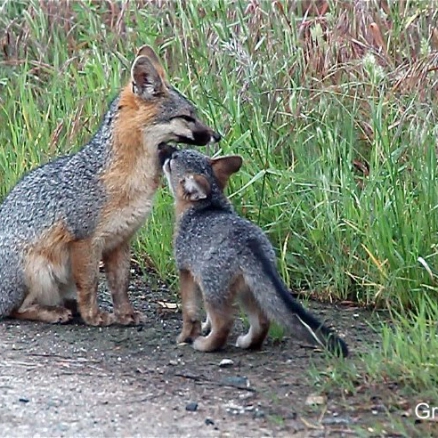
Gray Fox Playfulness “Hugging” Behaviors.
See the violence of Discipline Raccoon Style.

“How to be a Fox” The article about Bill and his ethological approach to his study of the gray fox is online here. Many are calling this a major article in the wildlife press.

Be Sure to check out our YouTube Channel for some incredible wildlife videos.
Grey Fox General Health
NEWS FLASH — There are a pair of gray foxes in the Palo Alto Baylands Nature Preserve. They have denned up on the north side of Matadero Creek. The family of red foxes along with a coyote pack of five – four youngsters and an adult — have moved into the territory. Presently, we are monitoring them.
Gray Fox, Baylands Goals
Within the permit that allows the Urban Wildlife Research Project to conduct its study of the behavior of the gray fox at the Palo Alto Baylands Nature Preserve, the objectives covered are:
- Monitoring of urban gray fox Denning sites in Palo Alto Baylands.
This is being accomplished during the period when the gray foxes use a den site. It is one of the prime locations for gathering most of the behavioral data of the litter and for adults alike.
- Assessment of status and population trends of Baylands urban gray foxes.
Since January 2019 a pair of resident gray foxes have claimed territory at the Palo Alto Baylands Nature Preserve.
- Identification of habitat features that promote the presence of urban gray foxes.
The Urban Wildlife Research Project is working on a project to remove the concrete from Matadero Creek that will create linkages and corridors between the Santa Cruz Mountain Range and the Palo Alto baylands..
- Assessment of reproductive success and identification of factors that promote successful reproduction.
Open the pinch-point along Matadero Creek by developing thickets that link one area to another, instead of the present island-like habitat.
- Identification and assessment of possible dispersal travel routes.
Dispersal routes move between the Palo Alto Baylands Nature Preserve and the Shoreline region over in Mountain View. In a north-westerly direction the dispersal corridors run just behind the homes bordering the marshlands in East Palo Alto.
Read more about UWRP in the news: