by William C. Leikam
President, CEO & Co-founder, Urban Wildlife Research Project
The Poacher
A Grizzly Discovery Evening 12/1/2017
That Friday evening, December first, shortly before 5:00 PM, I walked out into the overflow channel along Matadero Creek. Across the concrete channel near some willow trees, I noticed something red, something I’d never seen there before. I casually walked over to it and looked down. Stunned, I stared at two freshly laid-out carcasses, animals stripped of their fur. It took a moment for everything to register, and even then, I had no idea what kind of animals I was looking at. As I gathered my thoughts and walked back under the trees, I took a closer look and realized there were two skinned raccoons lying there. I checked around for anything more and found three snares hanging from a nearby branch.
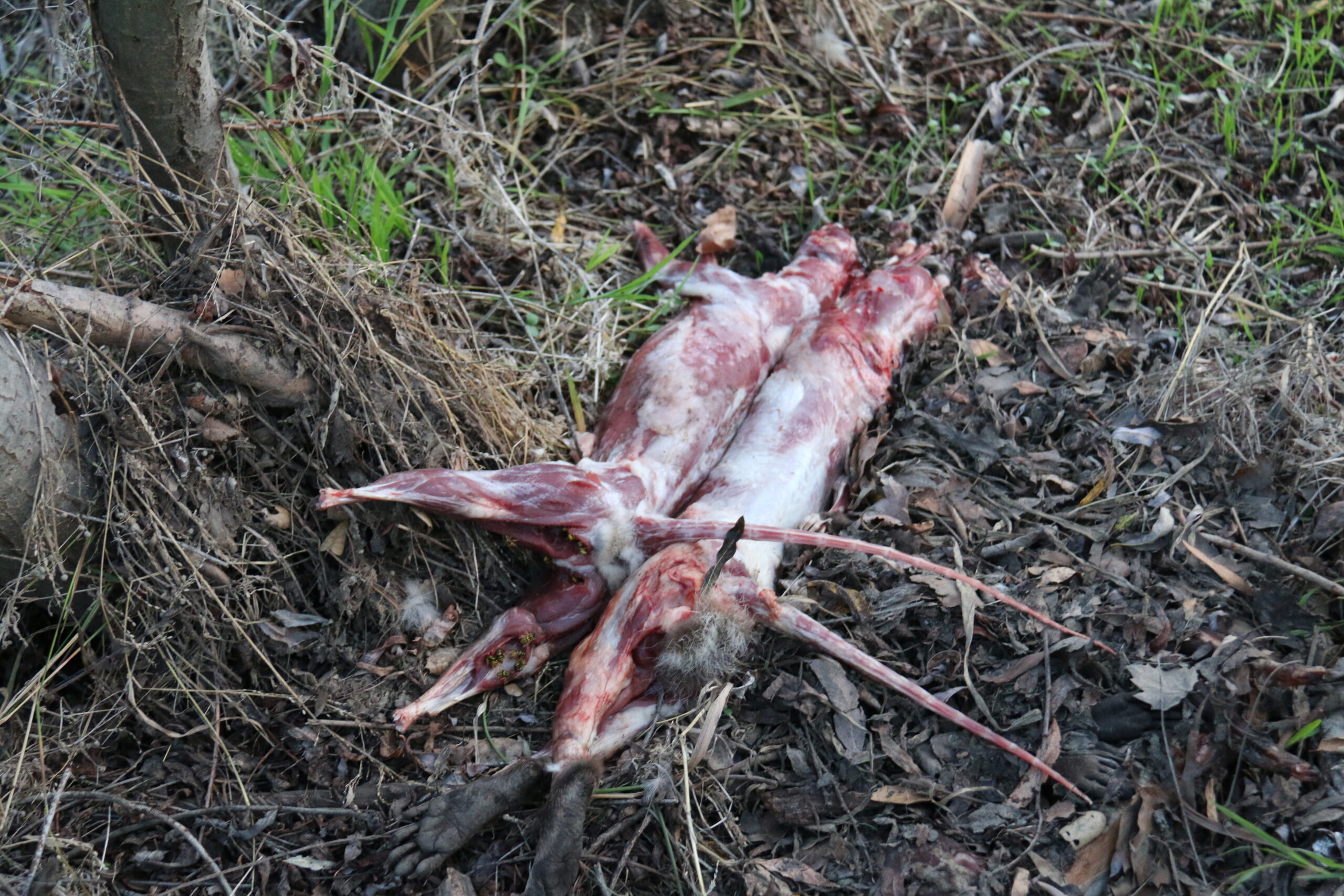
I called Police Dispatch to request that an Animal Services staff member come out and pick them up. However, James, who was on duty that evening, was running about an hour and a half to two hours behind schedule and would not be able to arrive until roughly 7:00 PM. I told dispatch where the raccoons were located. I left, hoping James would be able to find them in the dark.
The Following Morning 12/2/2017
I parked at the Matadero Creek Bridge at 7:15 AM. On my way down the trail to the overflow channel, I first noticed that someone had been there after I left the previous evening because the No Trespassing sign on the trail to the overflow channel had been rotated 180 degrees and now faced the channel instead of the trail, where trespassers would be coming down into the immediate area. I walked over to where the raccoons lay and saw they had not yet been collected by Animal Services. One of the dead raccoons had been pulled away from where it had lain. Its hind leg had been nibbled. The snares that had been in the tree were gone. I went back into the trees for my trail camera, but it was not where I had posted it. Down the channel, I found a spatula/scraper between Markers 22 & 23. Another 10 feet down the channel, I found a small marshmallow. I thought, “Bet that’s the bait they used.” On down toward the ditch, there was broken glass. Neither the spatula, the marshmallow, nor the glass had been there the day before.
That Saturday morning, around 10:00 AM, James from Animal Services called. He had just returned to his office with five dead raccoons. We discussed the situation and what we might do about it. He suggested that I contact the rangers and file a report. I replied that I had just done so and would follow up by phone.
Ranger Johnny answered. When he caught the gist of what I was saying, he asked, “Can you meet me at the bridge? I’ll tell you in person what happened last night.”
As I waited for Johnny to arrive, I wondered, “How can a person do such a thing as that? I don’t think they could if they heard the cubs’ calling’ in that low, rolling guttural purr they make when separated from their mother. I’d heard that distress call many times. I knew that there were cubs out there in the woods along the creek, frantic to find their mother. I remembered the way Mama raccoon wrestled with them, showing them how to defend themselves. I’d seen them wrestle and play hundreds of times, especially on my trail cameras. A tear broke. I wiped it away.
Johnny and I walked along the channel, and he told me the following story.
Normally, he gets off work at 3:30 PM, but on that Friday evening at about 6:00 PM, he was working at the city’s maintenance yard, the MSC, which backs up to the overflow channel and the creek. A chain-link fence separates the channel from the yard. He said that as he worked, he noticed a guy riding a bicycle down in the channel. Because it was already dark, the guy had a high-powered light strapped to his cap. As the guy drew closer, Johnny saw that he wore knee-length shorts and carried a large backpack.
The guy stopped directly across from where Johnny was hiding and watched. He unpacked his backpack, rummaged around for a couple of minutes, then went back under the trees. About 15 minutes later, the guy came back out and rode away.
Johnny said that everything looked very suspicious, so he called Police Dispatch and requested that an officer be sent out to help him. Within five minutes, a patrolman arrived. The two of them went down into the channel to where the poacher had gone back into the brush. There, under the canopy, the officer and Johnny found four leg-hold traps and one snare. (Those are vicious traps.) They collected them, found the snares, found a couple of other related items, and found that the guy used small marshmallows as bait. They picked it all up and took it in as evidence.
About a month later, Johnny worked a shift at the Pearson-Arastradero Preserve. He was making his rounds one early morning when he found a coyote hanging from a tree, and a part of the animal had been sliced open. The whole thing looked so fresh that Johnny decided to hide nearby just in case the person responsible returned.
And return he did. It turned out that the raccoon poacher was a 17-year-old visiting from Canada, where he’d learned about using traps and snares to capture wild animals and sell their fur. Several months later, he was reprimanded at a juvenile court hearing.
Comments are welcome.
What's Happening at UWRP?
Alie Ward’s podcast Ologies can be accessed on any of the podcast “stations” online such as Apple, Spotify iHeart, Podbay, or here at her website https://www.alieward.com/ologies/urocynology. If you chose the website, scroll down the page to find out more. In the very beginning there is a short advertisement before Alie and I get into the fray of it all. Enjoy. If you thought it worthwhile, please, spread the word through your personal networks.
Alie Ward will be doing a book special wherein she will promote my book the Road to Fox Hollow, along with other books published by those people who she interviewed this past year.
Read the latest about Bill in this new article posted on Palo Alto Online: Experts push for creek naturalization after rare beaver died in Palo Alto
Bill was interviewed for an article in the San Jose Mercury News about the effects of noise pollution upon wildlife. Although not quoted in the article, it’s still worth reading: “Learning How Noise Affects Wildlife” Urban sound is unavoidable, but its effects on threatened species are only beginning to be understood. Written by Claudia Steiner, December 27, 2025.
If you or your organization would like to have Bill aka the Fox Guy present one of his four PowerPoint presentations:
1. A Year with the Urban Gray Fox – MOST POPULAR
2. Human Development, Sixth Mass Extinction & Gray Foxes – An historical look at how we got to our present place in history.
3. Gray Fox Cognition – What & How Gray Foxes Perceive – This is a speculative attempt to get inside the mind of a gray fox
4. Corridors & Connections – Sustaining the Health of Our Wildlife – The title says it all
Contact us here https://urbanwildliferesearchproject.org/contact/ and let us know that you would like to have the Fox Guy give a presentation to your organization, corporation, or a home visit.
Bill will give a short presentation in the Elephant Room at Safari West, on July 25 at 8:00 PM. These are always fun events because the parents bring their kids to hear about foxes. Over the years that I’ve done this show; I find that the kids ask better questions than the adults.
Videos and Documentaries
My journey to the University of Zurich, Switzerland, Triggered By Motion
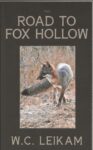
Bill’s book The Road to Fox Hollow can be purchased directly from Bill for a mere $20.00. Just email him through the Contact form on the Urban Wildlife Research Project’s website, leave your email address and he will get back to you. Or you can contact the publisher Di Angelo Publications .
A video documentary about Bill’s work with the foxes and produced at Stanford University by Syler Peralta-Ramos.
What happens when an opossum and a red fox meet in the night?
In contrast to two other raccoon discipline videos, this one is rather mild.
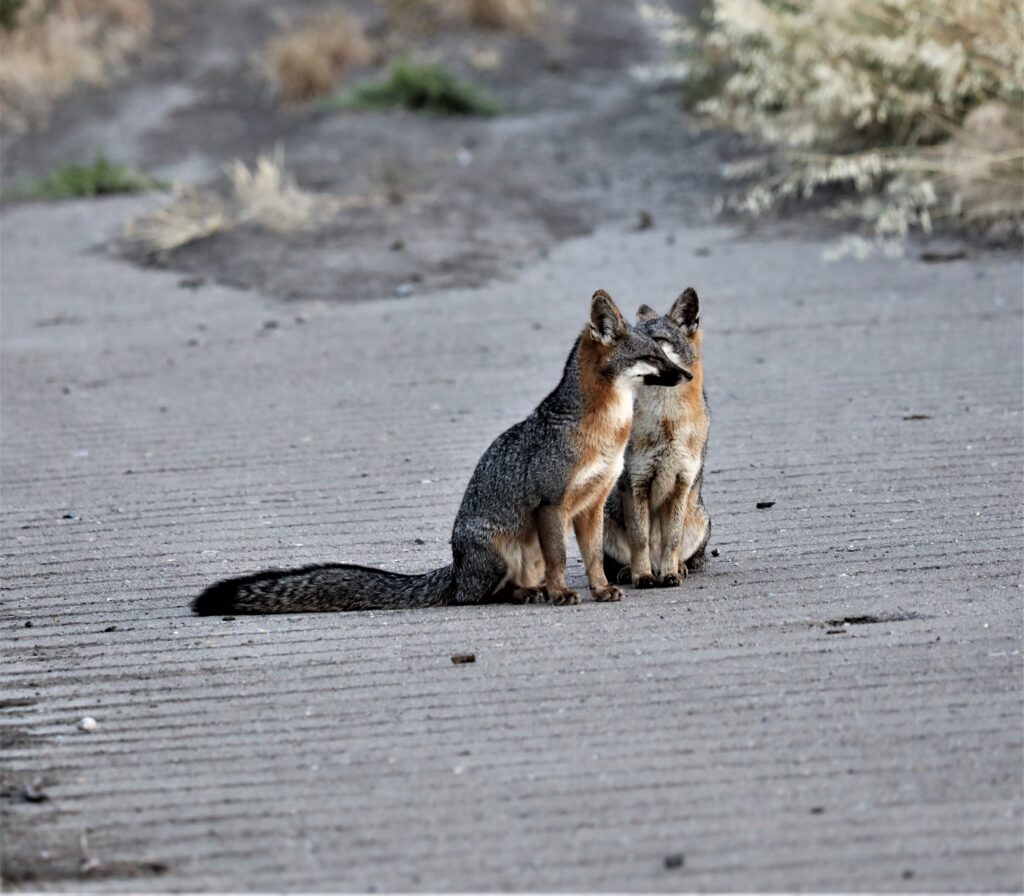
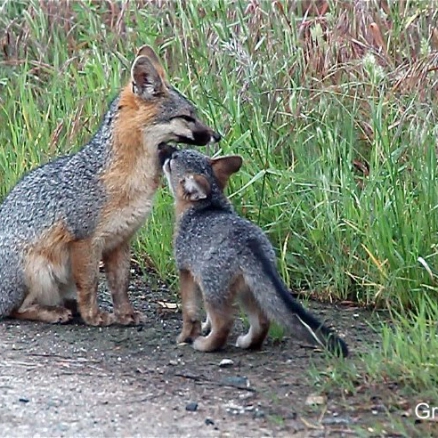
Gray Fox Playfulness “Hugging” Behaviors.
See the violence of Discipline Raccoon Style.
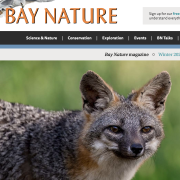
“How to be a Fox” The article about Bill and his ethological approach to his study of the gray fox is online here. Many are calling this a major article in the wildlife press.

Be Sure to check out our YouTube Channel for some incredible wildlife videos.
Grey Fox General Health
NEWS FLASH — The pair of gray foxes that were in the Palo Alto Baylands Nature Preserve several months ago have left the region probably due to the influx of red foxes, and a coyote pack of five – four youngsters and an adult. Presently, we are monitoring them.
Gray Fox, Baylands Goals
Within the permit that allows the Urban Wildlife Research Project to conduct its study of the behavior of the gray fox at the Palo Alto Baylands Nature Preserve, the objectives covered are:
- Monitoring of urban gray fox Denning sites in Palo Alto Baylands.
This is being accomplished during the period when the gray foxes use a den site. It is one of the prime locations for gathering most of the behavioral data of the litter and for adults alike.
- Assessment of status and population trends of Baylands urban gray foxes.
Since January 2019 a pair of resident gray foxes have claimed territory at the Palo Alto Baylands Nature Preserve.
- Identification of habitat features that promote the presence of urban gray foxes.
The Urban Wildlife Research Project is working on a project to remove the concrete from Matadero Creek that will create linkages and corridors between the Santa Cruz Mountain Range and the Palo Alto baylands..
- Assessment of reproductive success and identification of factors that promote successful reproduction.
Open the pinch-point along Matadero Creek by developing thickets that link one area to another, instead of the present island-like habitat.
- Identification and assessment of possible dispersal travel routes.
Dispersal routes move between the Palo Alto Baylands Nature Preserve and the Shoreline region over in Mountain View. In a north-westerly direction the dispersal corridors run just behind the homes bordering the marshlands in East Palo Alto.
Read more about UWRP in the news: