by William C. Leikam
President, CEO & Co-founder, Urban Wildlife Research Project
Divorce Gray Fox Style
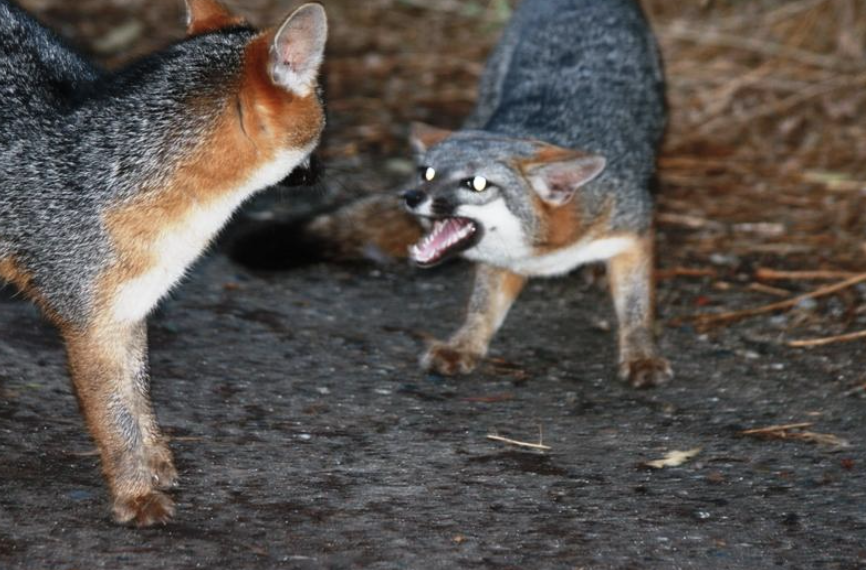
Within the domain of the wild, there have been tragedies, the bliss of finding a mate, young foxes chasing and wrestling with each other, living through seemingly endless droughts, fighting over territory, but likely the rarest and most unusual is when a gray fox couple divorce.
A Couple of Relevant Facts:
- Gray foxes are monogamous, most of the time.
- Although a gray fox female is biologically capable of having pups her first year, most often she doesn’t get pregnant that first year, or if so, she has a miscarriage. Most female gray foxes get pregnant in their second year of life.
The female gray fox named Little One was a small gray fox and I suspect in her second year of life. She had dispersed from the overflow channel along Matadero Creek and taken up territory out along the Adobe Loop Trail otherwise known as Perimeter Road. She lived alone in the brush along the trail and she likely hunted across Matadero Creek out into the vast floodplain. I’d pick her up on one of my trail cameras posted where I had seen her live on a few occasions. In February on one of those occasions, I saw her with another gray fox as they passed by the camera. I suspected that she’d found a mate.
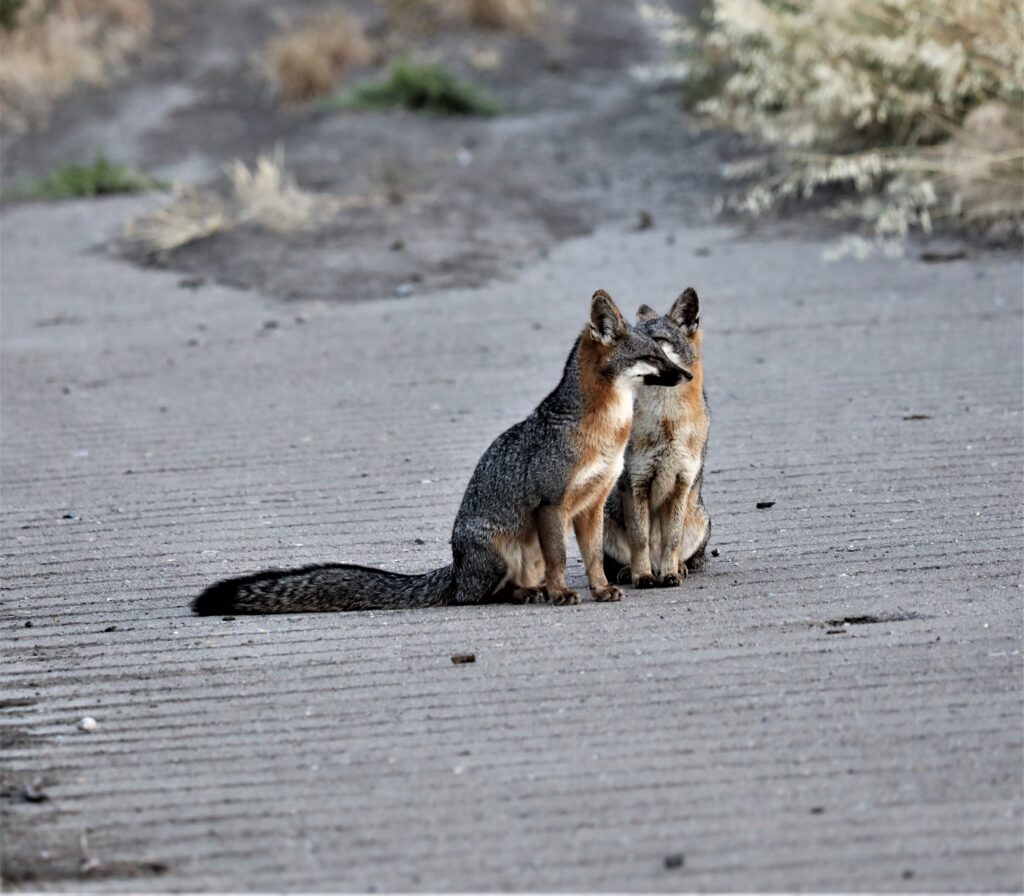
One early evening I headed toward Little One’s usual sleeping spot. I came around a turn. Two gray foxes approached, stopped, and then slowly drew closer. I stopped just to see what these two might do. The smaller of the two moved off the trail, into the brush, but the other one kept coming. He stopped at about 15 feet away and that was enough for me to get a good look at him. I decided that since he had more of that rusty-brown color on his chest and up around his face than a normal gray fox that I’d call him Brownie.
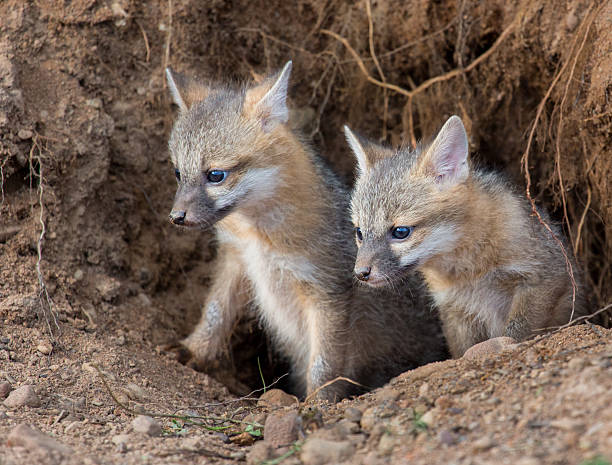
So, with that we had a pair and over time when the two of them were lying off in the weeds beside the trail, they didn’t run. I took loads of photos of them, and chattered at them on occasion. I documented their behavior. That first year that Brownie came into Little One’s home range they had three pups. Often the two of the three played in the weeds just off the trail, but one of them did not play. It looked sickly, moved slowly, and seemingly had no energy. Eventually that little pup failed to show up with its siblings and I suspected that he had died.
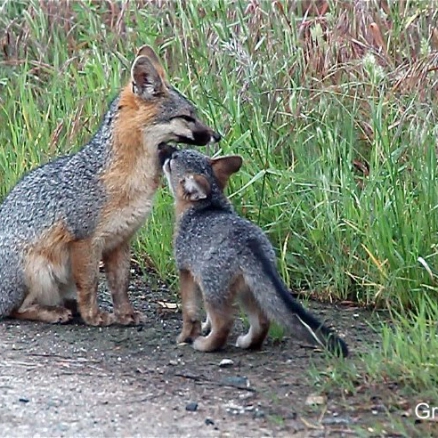
It was April again in their second year together. This time they had five pups, all healthy and running, wrestling, squealing and just having fun. They were not at all skittish, as they had seen both Brownie and their mom Little One having accepted me into their environment. On one occasion in the early afternoon, I watched the five pups playing. I jotted down notes on which one may likely become the alpha pup. Little One and Brownie lay nearby. I was about ready to leave, when I looked to my right along the Adobe Loop Trail and stepping from the brush came an adult gray fox. In that moment, I thought that it must be a trespasser and it would trot off in the opposite direction, but instead it trotted toward me.
I was surprised. At about twenty feet from me, that fox slipped off into the brush. I waited and watched. In less than a minute, that fox entered the area where Little One, Brownie and their pups were gathered. The pups gave this newcomer fox kisses. Obviously, they already knew this fox. I came to call her Helper, for she was the first documented case of a helper female helping a gray fox couple with too many little ones.
Going into their third year together, Helper continued to occupy the territory. It was about mid-March when I began to see changes. Brownie and Helper hung around together and before long the two of them left Little One’s home range and took up lodging out on the salt marsh under a large abandoned building. There were numerous times when checking my trail cameras in Little One’s territory that I’d find her trotting along the road. I’d follow to see where she went, and invariably she walked out into the marsh and headed straight for the large building where Brownie and Helper lived. I could tell by the way she walked that she must have been depressed, and she lacked the spark that she had once displayed. It took me a couple of months to finally conclude that Brownie had divorced Little One. She hung around for those months, but finally, I no longer saw her either live along the trail, or on my cameras. She must have left the region, likely broken hearted.
Until next month, enjoy the wildlife living in your backyard, and keep them safe.
What's Happening at UWRP?
Alie Ward’s podcast Ologies can be accessed on any of the podcast “stations” online such as Apple, Spotify iHeart, Podbay, or here at her website https://www.alieward.com/ologies/urocynology. If you chose the website, scroll down the page to find out more. In the very beginning there is a short advertisement before she and I get into the fray of it all. Enjoy.
If you thought it worthwhile, please, spread the word through your personal networks.
Alie Ward will be doing a book special wherein she will promote my book the Road to Fox Hollow, along with other books published by those people who she interviewed this past year.
Read the latest about Bill in this new article posted on Palo Alto Online: Experts push for creek naturalization after rare beaver died in Palo Alto
Bill was interviewed for an article in the San Jose Mercury News about the effects of noise pollution upon wildlife. Although not quoted in the article, it’s still worth reading: “Learning How Noise Affects Wildlife” Urban sound is unavoidable, but its effects on threatened species are only beginning to be understood. Written by Claudia Steiner, December 27, 2025.
If you or your organization would like to have Bill aka the Fox Guy present one of his four PowerPoint presentations:
1. A Year with the Urban Gray Fox – MOST POPULAR
2. Human Development, Sixth Mass Extinction & Gray Foxes – An historical look at how we got to our present place in history.
3. Gray Fox Cognition – What & How Gray Foxes Perceive – This is a speculative attempt to get inside the mind of a gray fox
4. Corridors & Connections – Sustaining the Health of Our Wildlife – The title says it all
Contact us here https://urbanwildliferesearchproject.org/contact/ and let us know that you would like to have the Fox Guy give a presentation to your organization, corporation, or a home visit.
On April 18, Bill and an assistant will be at a tabling event at Safari West (https://safariwest.com/) . Come join us on that date. This is a large gathering of most wildlife related organizations in the San Francisco Bay Area.
Bill will give a short presentation in the Elephant Room at Safari West, on July 25 at 8:00 PM. These are always fun events because the parents bring their kids to hear about foxes. Over the years that I’ve done this show, I find that the kids ask better questions than the adults.
Videos and Documentaries

My journey to the University of Zurich, Switzerland, Triggered By Motion
Bill’s book The Road to Fox Hollow can be purchased directly from Bill for a mere $20.00. Just email him through the Contact form on the Urban Wildlife Research Project’s website, leave your email address and he will get back to you. Or you can contact the publisher Di Angelo Publications .
A video documentary about Bill’s work with the foxes and produced at Stanford University by Syler Peralta-Ramos.
What happens when an opossum and a red fox meet in the night?
In contrast to two other raccoon discipline videos, this one is rather mild.
Gray Fox Playfulness “Hugging” Behaviors.
See the violence of Discipline Raccoon Style.

“How to be a Fox” The article about Bill and his ethological approach to his study of the gray fox is online here. Many are calling this a major article in the wildlife press.

Be Sure to check out our YouTube Channel for some incredible wildlife videos.
Grey Fox General Health
NEWS FLASH — The pair of gray foxes that were in the Palo Alto Baylands Nature Preserve several months ago have left the region probably due to the influx of red foxes, and a coyote pack of five – four youngsters and an adult. Presently, we are monitoring them.
Gray Fox, Baylands Goals
Within the permit that allows the Urban Wildlife Research Project to conduct its study of the behavior of the gray fox at the Palo Alto Baylands Nature Preserve, the objectives covered are:
- Monitoring of urban gray fox Denning sites in Palo Alto Baylands.
This is being accomplished during the period when the gray foxes use a den site. It is one of the prime locations for gathering most of the behavioral data of the litter and for adults alike.
- Assessment of status and population trends of Baylands urban gray foxes.
Since January 2019 a pair of resident gray foxes have claimed territory at the Palo Alto Baylands Nature Preserve.
- Identification of habitat features that promote the presence of urban gray foxes.
The Urban Wildlife Research Project is working on a project to remove the concrete from Matadero Creek that will create linkages and corridors between the Santa Cruz Mountain Range and the Palo Alto baylands..
- Assessment of reproductive success and identification of factors that promote successful reproduction.
Open the pinch-point along Matadero Creek by developing thickets that link one area to another, instead of the present island-like habitat.
- Identification and assessment of possible dispersal travel routes.
Dispersal routes move between the Palo Alto Baylands Nature Preserve and the Shoreline region over in Mountain View. In a north-westerly direction the dispersal corridors run just behind the homes bordering the marshlands in East Palo Alto.
Read more about UWRP in the news: