by William C. Leikam
President, CEO & Co-founder, Urban Wildlife Research Project
Dangerous Trespassing: Big Eyes and Flop
Scat - Part 3
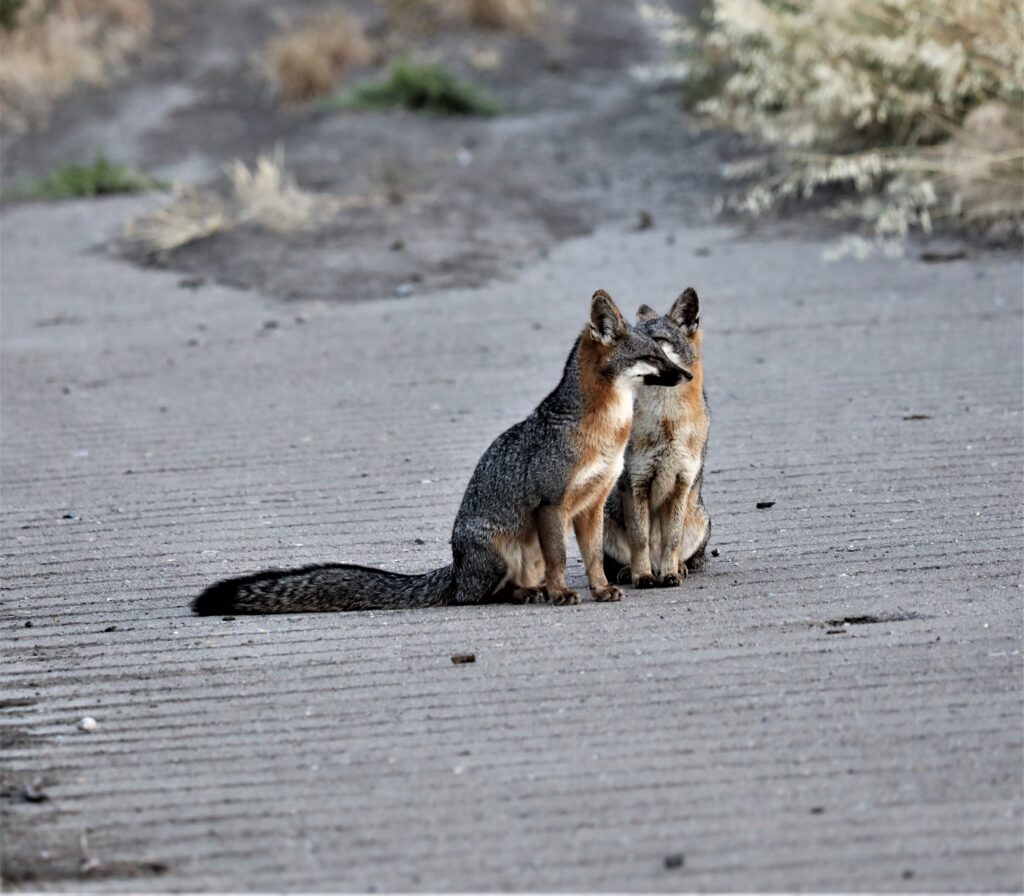
Laimos and Big Eyes had come into the south side of Matadero Creek on January 24, 2019. They had travelled through the thickets bordering Adobe Creek, and across the vast floodplain that separates the Shoreline Amphitheater ecosystem and the Palo Alto Baylands. It was about a two-week journey. Once they had arrived, they marked their territory with scat and urine, announcing to all comers that they “ruled” and “owned” that region of the landscape: Trespassers beware.
On August, 2nd 2019, a young gray fox showed up on one of our trail cameras that was located along the Matadero Creek overflow channel; a concrete slab some 15 feet wide running nearly 1,100 feet alongside Matadero Creek. Since Laimos and Big Eyes were adamant about keeping others out of their territory, they were always scat-marking in numerous places along the channel, so that if a trespasser did come into the region, it couldn’t miss knowing that this area was already inhabited by a gray fox pair.
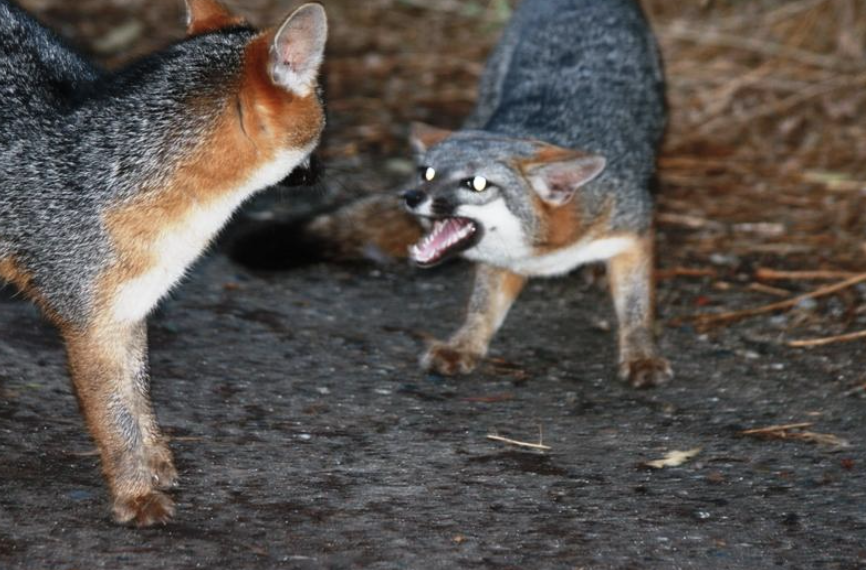
This young female, who we named Flop, had a floppy right ear with a blue tag in it. When she first came into the region, from what could be seen on the trail cameras, everything between Big Eyes, Laimos and Flop seemed relatively peaceful. Surprisingly, we did not see significant fights until August 8th 2019 at the ditch just off of Matadero Creek. Like most fox fights it was fast and furious. Another fight took place on August 27th and 28th. On the 27th there were two fights that night at two different camera locations. These were serious fights, one of them lasting about seven to ten seconds. That’s a serious engagement because most fox fights last no more than three to four seconds, if even that. The fight on the 28th is rather curious because it’s not a regular bite and claw. In this one Big Eyes attacks Flop by rearing up on her hind legs and lurching at Flop, they have a brief shouting match, open mouths, growls and within seconds it ended. Flop wasn’t deterred by it for when the fight was over, she simply returned to foraging over in the weeds nearby, and Big Eyes just walked away along Creek Trail.
Flop had not been deterred by these fights, but on one occasion along the overflow channel, Big Eyes met Flop in broad daylight and in my presence. The two foxes circled and growled. Flop gave forth a yip and Big Eyes circled in closer, ready to attack Flop with all of her force. I stood there with my camera taking still and video shots of the scene before me. It seemed as if both gray foxes dashed together at the same instant. The fight went on and on with screams and “barks”, shrieks, and noises that I have no words for. When the fight was over, Flop dashed off into the brush. I couldn’t tell if she had been injured or not, but that was the last time that we saw Flop in the channel. Big Eyes simply trotted away.
Probably a month or so later Ryan from over at the Mountain View, Shoreline complex sent me an email asking if we tagged any of the foxes in the Palo Alto Baylands. I wrote back that we didn’t and asked why.
Ryan replied, “Well, we have been live-trapping feral cats out here, and in one of the traps we got a female gray fox with a blue tag in her ear.” I replied, “Yeah, I know that fox. It was over here, but was driven out by our two resident gray foxes, Laimos and Big Eyes.”
And so, scat marks territory, and trespassing can lead to unwelcomed encounters. Until next month, take care of your environment and the critters that live therein. Remember, they are sentient critters that have an emotional as well as a cognitive, thinking life.
What's Happening at UWRP?
Alie Ward’s podcast Ologies can be accessed on any of the podcast “stations” online such as Apple, Spotify iHeart, Podbay, or here at her website https://www.alieward.com/ologies/urocynology. If you chose the website, scroll down the page to find out more. In the very beginning there is a short advertisement before she and I get into the fray of it all. Enjoy.
If you thought it worthwhile, please, spread the word through your personal networks.
Read the latest about Bill in this new article posted on Palo Alto Online: Experts push for creek naturalization after rare beaver died in Palo Alto
Bill was interviewed for an article in the San Jose Mercury News about the effects of noise pollution upon wildlife. The article is yet to be published.
If you or your organization would like to have Bill aka the Fox Guy present one of his four PowerPoint presentations:
1. A Year with the Urban Gray Fox – MOST POPULAR
2. Human Development, Sixth Mass Extinction & Gray Foxes – An historical look at how we got to our present place in history.
3. Gray Fox Cognition – What & How Gray Foxes Perceive – This is a speculative attempt to get inside the mind of a gray fox
4. Corridors & Connections – Sustaining the Health of Our Wildlife – The title says it all
Contact us here https://urbanwildliferesearchproject.org/contact/ and let us know that you would like to have the Fox Guy give a presentation to your organization, corporation, or a home visit.
On June 14, Bill gave a short presentation in the Elephant Room at Safari West, at 8:00 PM. We had a full house and, in the Q, & A segment several interesting questions were asked including, “In the community of gray foxes, do you think there are any LGBTQ foxes?” I replied, “Yes. Science has shown that there are such individuals in many mammal communities. In the fox community, there are some that never pair up with a mate of the opposite sex.”
Videos and Documentaries
My journey to the University of Zurich, Switzerland, Triggered By Motion
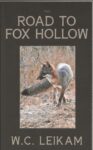
Bill’s book The Road to Fox Hollow can be purchased directly from Bill for a mere $20.00. Just email him through the Contact form on the Urban Wildlife Research Project’s website, leave your email address and he will get back to you. Or you can contact the publisher Di Angelo Publications .
A video documentary about Bill’s work with the foxes and produced at Stanford University by Syler Peralta-Ramos.
What happens when an opossum and a red fox meet in the night?
In contrast to two other raccoon discipline videos, this one is rather mild.
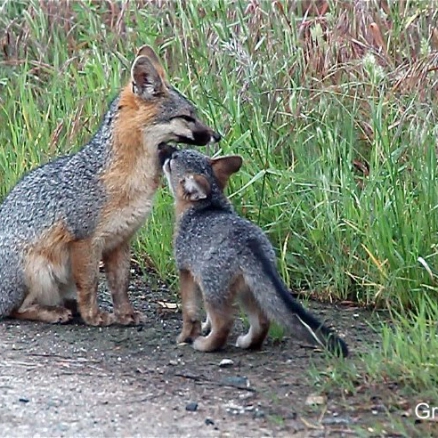
Gray Fox Playfulness “Hugging” Behaviors.
See the violence of Discipline Raccoon Style.

“How to be a Fox” The article about Bill and his ethological approach to his study of the gray fox is online here. Many are calling this a major article in the wildlife press.

Be Sure to check out our YouTube Channel for some incredible wildlife videos.
Grey Fox General Health
NEWS FLASH — There are a pair of gray foxes in the Palo Alto Baylands Nature Preserve. They have denned up on the north side of Matadero Creek. The family of red foxes along with a coyote pack of five – four youngsters and an adult — have moved into the territory. Presently, we are monitoring them.
Gray Fox, Baylands Goals
Within the permit that allows the Urban Wildlife Research Project to conduct its study of the behavior of the gray fox at the Palo Alto Baylands Nature Preserve, the objectives covered are:
- Monitoring of urban gray fox Denning sites in Palo Alto Baylands.
This is being accomplished during the period when the gray foxes use a den site. It is one of the prime locations for gathering most of the behavioral data of the litter and for adults alike.
- Assessment of status and population trends of Baylands urban gray foxes.
Since January 2019 a pair of resident gray foxes have claimed territory at the Palo Alto Baylands Nature Preserve.
- Identification of habitat features that promote the presence of urban gray foxes.
The Urban Wildlife Research Project is working on a project to remove the concrete from Matadero Creek that will create linkages and corridors between the Santa Cruz Mountain Range and the Palo Alto baylands..
- Assessment of reproductive success and identification of factors that promote successful reproduction.
Open the pinch-point along Matadero Creek by developing thickets that link one area to another, instead of the present island-like habitat.
- Identification and assessment of possible dispersal travel routes.
Dispersal routes move between the Palo Alto Baylands Nature Preserve and the Shoreline region over in Mountain View. In a north-westerly direction the dispersal corridors run just behind the homes bordering the marshlands in East Palo Alto.
Read more about UWRP in the news: