by William C. Leikam
President, CEO & Co-founder, Urban Wildlife Research Project
The Chase
Biologist Carol and I stood on the concrete overflow channel along Matadero Creek listening to the crashing through, the breaking of tree branches, the sounds of a chase through the brushy riparian habitat between us and the creek. We both were in awe of what we heard, because it was obvious that these two foxes were not following any of the trails there in the brush. In short, they were crashing headlong through the dead trees, the weeds, the whole of the understory.
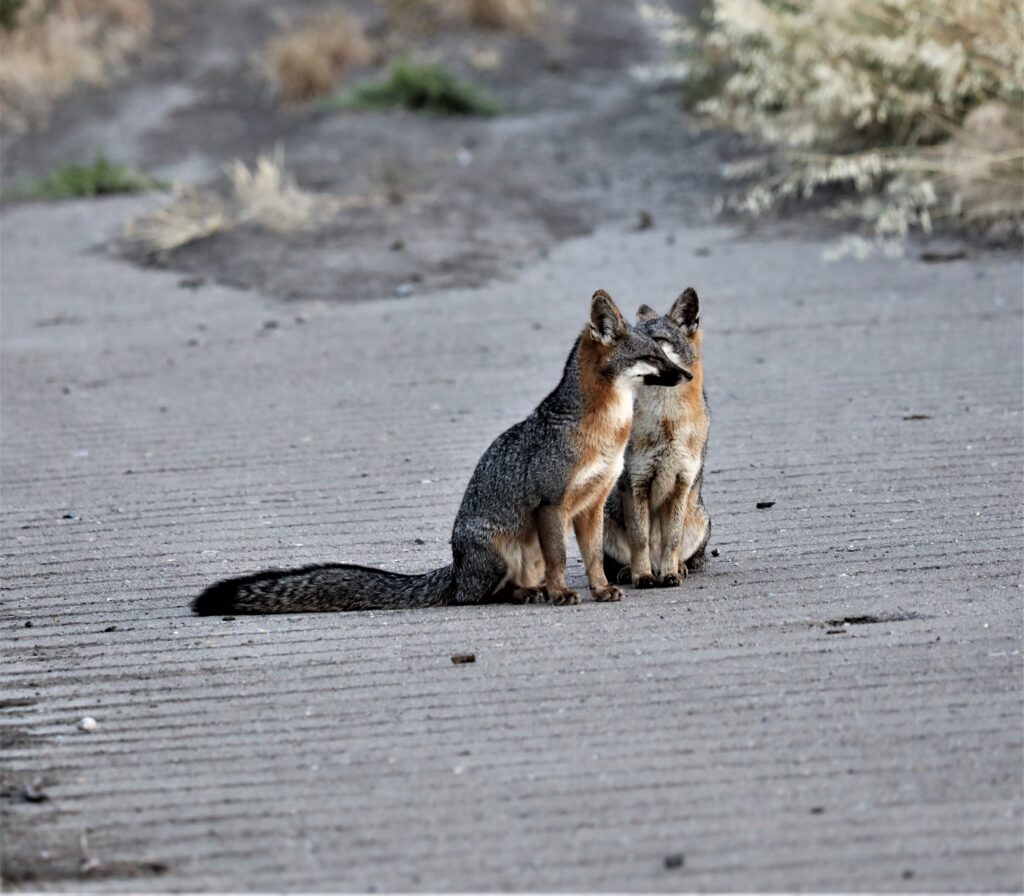
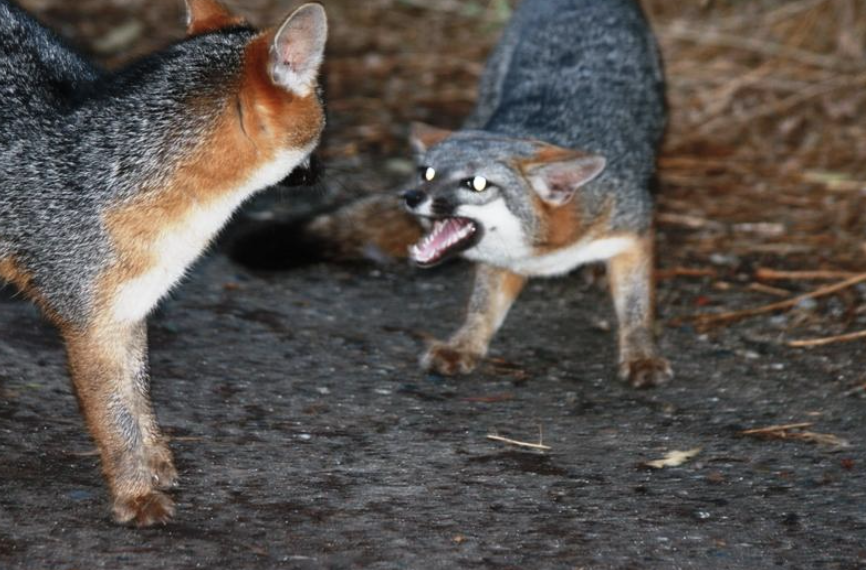
We had seen it begin. The alpha male Dark had been some 50 feet or so downstream in the channel from us, and the single, unattached male gray fox Blue stood on a small berm about 30 feet from us, near channel marker #17. He watched Dark.
It felt like Blue was taunting him, almost as if to say, “Hey, old fox, chase me if you will, but I will not leave.” It was an annual chase. In February, when the females are in estrus, Dark annually establishes his dominance over all others, especially the single males like Blue. Most of those males knew the ritual, and so after a single chase, or not even that, those males left the south side of the creek and set up sleeping quarters over on the north bank of Matadero Creek. Blue was the exception.
As we listened to the crashing of the brush, it subsided, and then all was still. We paused. I asked Carol, “What do you think?”
She replied, “In all my years working as a field biologist, working hand-in-hand with wild critters, never have I ever seen anything comparable. This is simply amazing.”
I went on to explain that Dark was aloof and high-strung. Once in a while, I saw his mate, Cute, want some affection from him, but he just shunned her and walked away. He sometimes did the same when his pup Midget wanted to play. At certain times of the year, he kept order in that overcrowded riparian habitat where upwards of 16 gray foxes called that habitat home. There was nowhere else for them to go, there on the banks of Matadero Creek.
We realized the crashing had stopped and assumed the foxes were downstream of us. We walked in that direction, just in case one or the other would come out onto the channel. Neither of them emerged. As we walked back upstream along the overflow channel, suddenly, there in the berm stood Blue. I looked back downstream in the concrete channel. Dark bounded out of the brush. He clearly saw Blue over near marker #17.
We assessed the situation. I asked, “You think we’ll get a rerun?” At that moment, Dark turned and trotted off, back toward his natal den. Eventually, Blue did go to the north side of Matadero Creek, where he spent time with other foxes such as Tense and her sister Tippy, the young female Creek, and Little One.
That’s just a brief glimpse into gray fox behavior when they are forced to live in such tight quarters. In working in the field and watching these foxes up close and personal, I have seen behavior that runs the gamut of emotions, thinking (cognitive behavior), and their ability to feed themselves and their young.
Comments, both positive and negative, are welcome.
What's Happening at UWRP?
Alie Ward’s podcast Ologies can be accessed on any of the podcast “stations” online such as Apple, Spotify iHeart, Podbay, or here at her website https://www.alieward.com/ologies/urocynology. If you chose the website, scroll down the page to find out more. In the very beginning there is a short advertisement before Alie and I get into the fray of it all. Enjoy. If you thought it worthwhile, please, spread the word through your personal networks.
Alie Ward will be doing a book special wherein she will promote my book the Road to Fox Hollow, along with other books published by those people who she interviewed this past year.
Read the latest about Bill in this new article posted on Palo Alto Online: Experts push for creek naturalization after rare beaver died in Palo Alto
Bill was interviewed for an article in the San Jose Mercury News about the effects of noise pollution upon wildlife. Although not quoted in the article, it’s still worth reading: “Learning How Noise Affects Wildlife” Urban sound is unavoidable, but its effects on threatened species are only beginning to be understood. Written by Claudia Steiner, December 27, 2025.
If you or your organization would like to have Bill aka the Fox Guy present one of his four PowerPoint presentations:
1. A Year with the Urban Gray Fox – MOST POPULAR
2. Human Development, Sixth Mass Extinction & Gray Foxes – An historical look at how we got to our present place in history.
3. Gray Fox Cognition – What & How Gray Foxes Perceive – This is a speculative attempt to get inside the mind of a gray fox
4. Corridors & Connections – Sustaining the Health of Our Wildlife – The title says it all
Contact us here https://urbanwildliferesearchproject.org/contact/ and let us know that you would like to have the Fox Guy give a presentation to your organization, corporation, or a home visit.
Bill will give a short presentation in the Elephant Room at Safari West, on July 25 at 8:00 PM. These are always fun events because the parents bring their kids to hear about foxes. Over the years that I’ve done this show; I find that the kids ask better questions than the adults.
Videos and Documentaries
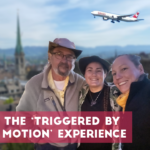
My journey to the University of Zurich, Switzerland, Triggered By Motion
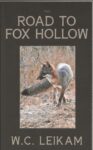
Bill’s book The Road to Fox Hollow can be purchased directly from Bill for a mere $20.00. Just email him through the Contact form on the Urban Wildlife Research Project’s website, leave your email address and he will get back to you. Or you can contact the publisher Di Angelo Publications .
A video documentary about Bill’s work with the foxes and produced at Stanford University by Syler Peralta-Ramos.
What happens when an opossum and a red fox meet in the night?
In contrast to two other raccoon discipline videos, this one is rather mild.
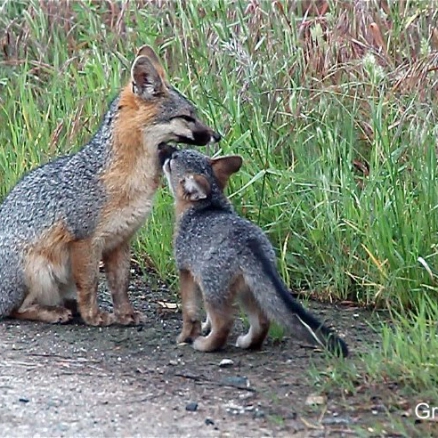
Gray Fox Playfulness “Hugging” Behaviors.
See the violence of Discipline Raccoon Style.

“How to be a Fox” The article about Bill and his ethological approach to his study of the gray fox is online here. Many are calling this a major article in the wildlife press.

Be Sure to check out our YouTube Channel for some incredible wildlife videos.
Grey Fox General Health
NEWS FLASH — The pair of gray foxes that were in the Palo Alto Baylands Nature Preserve several months ago have left the region probably due to the influx of red foxes, and a coyote pack of five – four youngsters and an adult. Presently, we are monitoring them.
Gray Fox, Baylands Goals
Within the permit that allows the Urban Wildlife Research Project to conduct its study of the behavior of the gray fox at the Palo Alto Baylands Nature Preserve, the objectives covered are:
- Monitoring of urban gray fox Denning sites in Palo Alto Baylands.
This is being accomplished during the period when the gray foxes use a den site. It is one of the prime locations for gathering most of the behavioral data of the litter and for adults alike.
- Assessment of status and population trends of Baylands urban gray foxes.
Since January 2019 a pair of resident gray foxes have claimed territory at the Palo Alto Baylands Nature Preserve.
- Identification of habitat features that promote the presence of urban gray foxes.
The Urban Wildlife Research Project is working on a project to remove the concrete from Matadero Creek that will create linkages and corridors between the Santa Cruz Mountain Range and the Palo Alto baylands..
- Assessment of reproductive success and identification of factors that promote successful reproduction.
Open the pinch-point along Matadero Creek by developing thickets that link one area to another, instead of the present island-like habitat.
- Identification and assessment of possible dispersal travel routes.
Dispersal routes move between the Palo Alto Baylands Nature Preserve and the Shoreline region over in Mountain View. In a north-westerly direction the dispersal corridors run just behind the homes bordering the marshlands in East Palo Alto.
Read more about UWRP in the news: