by William C. Leikam
President, CEO & Co-founder, Urban Wildlife Research Project
In the Beginning - Part 1
For those of you who already understand the behaviors of wild critters, this will come as no surprise, but if you had been in my shoes in 2009, when I saw that first gray fox sitting beside the road in the area that I would eventually dub Fox Hollow, your life and mine would have been changed forever. I entered my study of the gray fox’s behavior by sheer accident. At that time, I did not know I was ready to head out on a journey that would forever change me as a human being. Prior to that meeting, I had thought very little about wild animals, and had you asked me to describe them, I would have tossed in words like instinct, mechanistic, and more dehumanizing terms like it.
One morning in mid-October 2009, at the Palo Alto Baylands Nature Preserve, I was out in the field birding for Bullock’s Orioles when ahead of me I saw a fox sitting beside the road. I had no idea what kind of fox it was, but my curiosity kicked in, and I slowly walked toward the galvanized pipe gate, taking photos of the fox beside that dirt road. I came up to the gate and took another photo. I was rather close to it, and I wondered if it had rabies or some other disease, for I had expected it to run, disappear back into the woods along the road. All the while, the fox watched me approach. When I walked around the edge of the gate, the fox stood up, turned, and disappeared into the brush.
The next day I returned, hoping to see a fox. Nothing. Two days later, just under the lip of the brush, three young foxes wrestled and played. I thought, “Oh my god, there’s not just one fox. There’s a whole family living here.” I hunkered down and took photos of them.
In the days that followed, whenever I arrived, their play stopped, and they stared at me. Two of them always retreated deeper into the brush, but one remained just under the edge, lying on its belly. I made a note of it, but I took it no further until one morning, when the fox that clung just under the edge of the brush shifted and stood.
I shifted my position. That fox dashed deep into the brush. I didn’t move. About two minutes later, it slowly emerged from the dense brush and walked toward the road. I had the impression that this little fox was as curious about me as I was about him. His two siblings watched from farther back in the brush. I remember thinking at the time that those two back in there must think, “He’s crazy going out there so close to the road, and besides there’s a human out there.”
Up to that point, I had not met any adults, but one morning, early, I stood on the edge of the road. I looked to my right toward the gate. Two adult gray foxes trotted toward me, each carrying something in its mouth. They stopped at the gate about 15 feet away. One lay flat on its belly. The other dashed past me. The one on the road dropped the rodent and growled. At that point, I wasn’t sure what to do. Out of my ignorance, I imagined this fox suddenly attacking me. After all, it was a wild animal. I looked for a stick, some kind of weapon to fend off an attacking gray fox. Instead, that fox picked up its prey and dashed past me. Little did I know about gray fox behavior.
Two days later, that courageous little fox I had been monitoring came out to the edge of the road. I watched it for maybe two minutes, and then, on a whim, I said, “Hey, little fox, hey, what cha doin’?” He had an expression of surprise on his face. That’s when I began talking to the foxes of the Palo Alto Baylands Nature Preserve, and at the same time I was getting tired of sitting on the damp, chilly ground. I decided to find a log to use as a stool. I found one up near the truck washing pad. Every morning when I visited there, across the road from their den, I sat on that old log and jotted down notes on what the fox was doing.
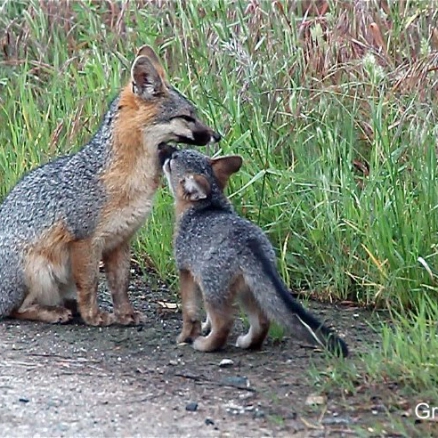
The bold little fox gradually crept farther out onto the road, and at the same time he began changing his baby color, mostly gray, to areas of rusty red, and his pudgy nose began to lengthen and transform into a snout. Around that stage in the development of these gray foxes, I wondered why they were born with a flat, pudgy nose that would, as an adult, lengthen into a snout. The answer didn’t come right away.
As he continued to come from the brush, one morning I walked up the road just to check whether there were any other foxes out in a small meadow near the truck washing pad. Nothing. I looked back down the road. That little fox was up on my stool, sniffing my scent.
To be continued – Comments, both positive and negative, are welcome.
What's Happening at UWRP?
Alie Ward’s podcast Ologies can be accessed on any of the podcast “stations” online such as Apple, Spotify iHeart, Podbay, or here at her website https://www.alieward.com/ologies/urocynology. If you chose the website, scroll down the page to find out more. In the very beginning there is a short advertisement before Alie and I get into the fray of it all. Enjoy. If you thought it worthwhile, please, spread the word through your personal networks.
Alie Ward will be doing a book special wherein she will promote my book the Road to Fox Hollow, along with other books published by those people who she interviewed this past year.
Read the latest about Bill in this new article posted on Palo Alto Online: Experts push for creek naturalization after rare beaver died in Palo Alto
Bill was interviewed for an article in the San Jose Mercury News about the effects of noise pollution upon wildlife. Although not quoted in the article, it’s still worth reading: “Learning How Noise Affects Wildlife” Urban sound is unavoidable, but its effects on threatened species are only beginning to be understood. Written by Claudia Steiner, December 27, 2025.
If you or your organization would like to have Bill aka the Fox Guy present one of his four PowerPoint presentations:
1. A Year with the Urban Gray Fox – MOST POPULAR
2. Human Development, Sixth Mass Extinction & Gray Foxes – An historical look at how we got to our present place in history.
3. Gray Fox Cognition – What & How Gray Foxes Perceive – This is a speculative attempt to get inside the mind of a gray fox
4. Corridors & Connections – Sustaining the Health of Our Wildlife – The title says it all
Contact us here https://urbanwildliferesearchproject.org/contact/ and let us know that you would like to have the Fox Guy give a presentation to your organization, corporation, or a home visit.
Videos and Documentaries
My journey to the University of Zurich, Switzerland, Triggered By Motion
Bill’s book The Road to Fox Hollow can be purchased directly from Bill for a mere $20.00. Just email him through the Contact form on the Urban Wildlife Research Project’s website, leave your email address and he will get back to you. Or you can contact the publisher Di Angelo Publications .
A video documentary about Bill’s work with the foxes and produced at Stanford University by Syler Peralta-Ramos.
What happens when an opossum and a red fox meet in the night?
In contrast to two other raccoon discipline videos, this one is rather mild.
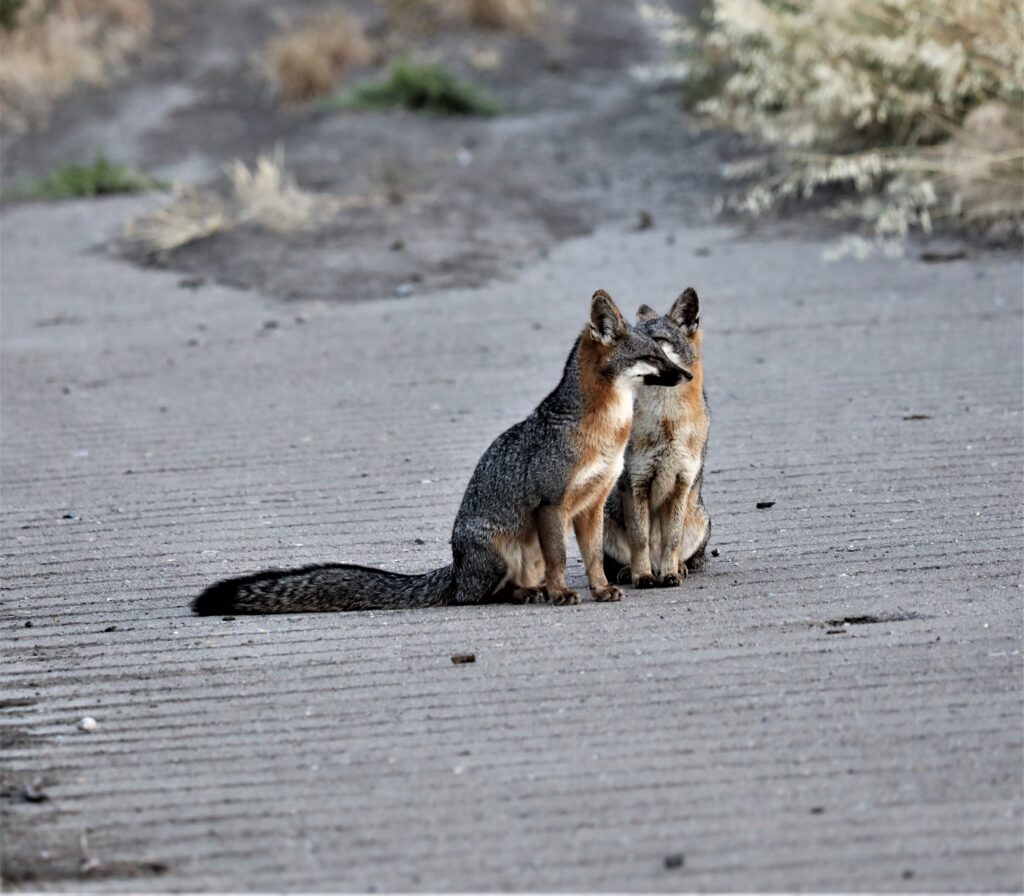
Gray Fox Playfulness “Hugging” Behaviors.
See the violence of Discipline Raccoon Style.

“How to be a Fox” The article about Bill and his ethological approach to his study of the gray fox is online here. Many are calling this a major article in the wildlife press.

Be Sure to check out our YouTube Channel for some incredible wildlife videos.
Grey Fox General Health
NEWS FLASH — The pair of gray foxes that were in the Palo Alto Baylands Nature Preserve several months ago have left the region probably due to the influx of red foxes, and a coyote pack of five – four youngsters and an adult. Presently, we are monitoring them.
Gray Fox, Baylands Goals
Within the permit that allows the Urban Wildlife Research Project to conduct its study of the behavior of the gray fox at the Palo Alto Baylands Nature Preserve, the objectives covered are:
- Monitoring of urban gray fox Denning sites in Palo Alto Baylands.
This is being accomplished during the period when the gray foxes use a den site. It is one of the prime locations for gathering most of the behavioral data of the litter and for adults alike.
- Assessment of status and population trends of Baylands urban gray foxes.
Since January 2019 a pair of resident gray foxes have claimed territory at the Palo Alto Baylands Nature Preserve.
- Identification of habitat features that promote the presence of urban gray foxes.
The Urban Wildlife Research Project is working on a project to remove the concrete from Matadero Creek that will create linkages and corridors between the Santa Cruz Mountain Range and the Palo Alto baylands..
- Assessment of reproductive success and identification of factors that promote successful reproduction.
Open the pinch-point along Matadero Creek by developing thickets that link one area to another, instead of the present island-like habitat.
- Identification and assessment of possible dispersal travel routes.
Dispersal routes move between the Palo Alto Baylands Nature Preserve and the Shoreline region over in Mountain View. In a north-westerly direction the dispersal corridors run just behind the homes bordering the marshlands in East Palo Alto.
Read more about UWRP in the news: