by William C. Leikam
President, CEO & Co-founder, Urban Wildlife Research Project
Be sure to check out the interview Bill did with Alie Ward for her internationally acclaimed podcast Ologies https://www.alieward.com/ologies/urocynology. More about this below.
The Historical eDNA Project
I’m going to diverge from what I have learned in this month’s Gray Fox Report. In the past month we here at the Urban Wildlife Research Project have completed an historical assessment of Matadero Creek, the creek that houses beavers, muskrats, foxes, raccoons, and many other critters, many of which were unknown until the results of the eDNA came in from Cramer Fish Sciences in Sacramento, California.
The Urban Wildlife Research Project (UWRP) conducted an environmental DNA (eDNA) survey of Matadero Creek in order to update our understanding of the fish and the study of amphibians and reptiles in the creek, and to see if federally threatened steelhead trout had managed to persist despite barriers to in-migrating spawning runs from the Bay up into the creek. The environmental DNA (eDNA) analysis employs metabarcoding to identify roughly 1,000 different fish, amphibians, and reptiles.
eDNA or environmental DNA is a system wherein analysis of water samples can determine what animals, birds, frogs, etc. live in and around where the samples were taken. The purpose of this eDNA project is linked to our larger project that is the removal of concrete from Matadero creek. We are building a case, a proposal, to remove eight miles of concrete from this creek so as to allow wildlife expansion from the Palo Alto Baylands Nature Preserve to the Santa Cruz Mountain Range. We needed to see if, in or along the banks of the creek there were any federally endangered or threatened species living anywhere along the length of the creek.
On May 17 and May 25, 2025, respectively, we collected water samples from 15 locations in the creek as part of a broad survey. Three samples were collected from the intertidal area of the Mayfield Slough and 12 samples from the upper perennial areas from Bol Park upstream of the mainstem of Matadero Creek and its two main tributaries, Deer Creek, and Arastradero Creek.
The eDNA survey found no evidence of steelhead/rainbow trout, suggesting that the tidal gate and the long concretized rectangular channel in Matadero Creek act as complete barriers to once historical trout spawning runs. Had we discovered any federally threatened steelhead or salmon, the case would have been made to open up the length of the creek. However, Pacific tree frog eDNA was found at many sites as were several native fish species including Sacramento sucker (https://en.wikipedia.org/wiki/Sacramento_sucker ), California roach, sculpin/probably inland riffle sculpin and three-spined stickleback. For the first time, Sacramento blackfish (Orthodon microlepidotus) were found in Matadero Creek using eDNA technology.
Overall, we were pleased to utilize this relatively new technology to better understand the species surviving our heavily altered creek. We were sad to see that steelhead trout have been lost from the system but pleased that other species like Pacific tree fogs managed to hang on. We also identified several man-made alterations to the creek badly in need of correction – the tidal gate lacks a portal to permit immigrating fish passage, the creek is buried in a pipe above Bol Park and under Interstate 280, and the long rectangular concretized channel from El Camino Real to US Highway 101 acts as a barrier to fish passage. Because the latter has no riparian cover, i.e. trees, bushes, and more, it also is unusable for mammals such as gray fox, bobcats, opossums, skunks, etc. If the concrete were to be removed, then these mammals could migrate from the baylands to the Santa Cruz Mountain uplands thus, over time, increasing the genetic health of the wildlife in the Palo Alto Baylands Nature Preserve.
What's Happening at UWRP?
The podcast can be accessed on any of the podcast “stations” online such as Apple, Spotify iHeart, Podbay, or here at her website https://www.alieward.com/ologies/urocynology. If you chose the website, scroll down the page to find out more. In the very beginning there is a short advertisement before she and I get into the fray of it all. Enjoy.
If you thought it worthwhile, please, spread the word through your personal networks.
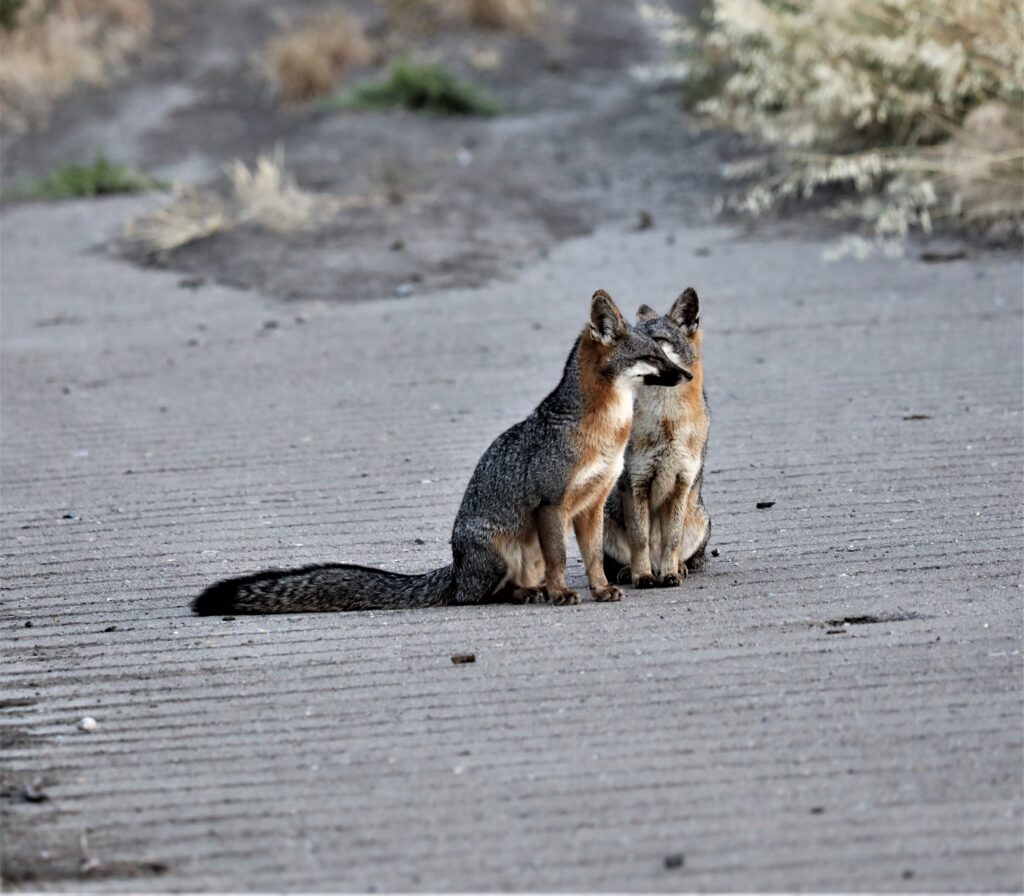
On June 14, Bill gave a short presentation in the Elephant Room at Safari West, at 8:00 PM. We had a full house and, in the Q, & A segment several interesting questions were asked including, “In the community of gray foxes, do you think there are any LGBTQ foxes?” I replied, “Yes. Science has shown that there are such individuals in many mammal communities. In the fox community, there are some that never pair up with a mate of the opposite sex.”
If you or your organization would like to have Bill aka the Fox Guy present one of his four PowerPoint presentations:
1. A Year with the Urban Gray Fox – MOST POPULAR
2. Human Development, Sixth Mass Extinction & Gray Foxes – An historical look at how we got to our present place in history.
3. Gray Fox Cognition – What & How Gray Foxes Perceive – This is an attempt to get inside the mind of a gray fox
4. Corridors & Connections – Sustaining the Health of Our Wildlife – The title says it all
Contact us here https://urbanwildliferesearchproject.org/contact/ and let us know.
Videos and Documentaries

My journey to the University of Zurich, Switzerland, Triggered By Motion
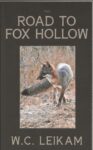
Bill’s book The Road to Fox Hollow can be purchased directly from Bill for a mere $20.00. Just email him through the Contact form on the Urban Wildlife Research Project’s website, leave your email address and he will get back to you. Or you can contact the publisher Di Angelo Publications .
A video documentary about Bill’s work with the foxes and produced at Stanford University by Syler Peralta-Ramos.
What happens when an opossum and a red fox meet in the night?
In contrast to two other raccoon discipline videos, this one is rather mild.
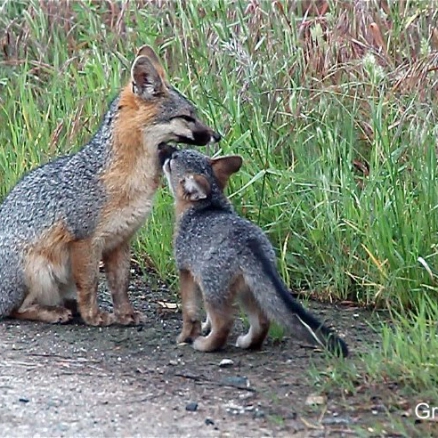
Gray Fox Playfulness “Hugging” Behaviors.
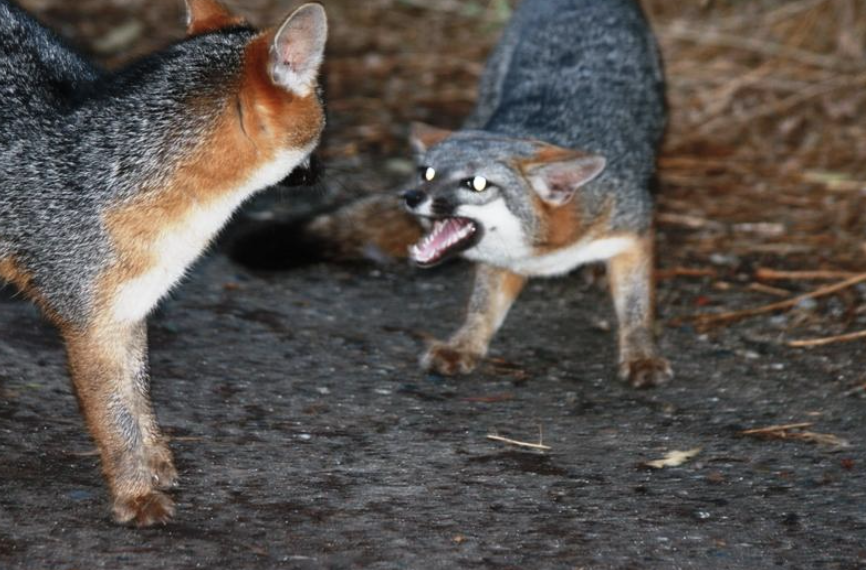
See the violence of Discipline Raccoon Style.
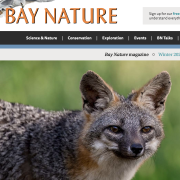
“How to be a Fox” The article about Bill and his ethological approach to his study of the gray fox is online here. Many are calling this a major article in the wildlife press.

Be Sure to check out our YouTube Channel for some incredible wildlife videos.
Grey Fox General Health
There are no gray foxes in the Palo Alto Baylands Nature Preserve. However, there is a family of three red foxes that have moved into the territory along with a coyote pair. Presently, we are monitoring them.
Gray Fox, Baylands Goals
Within the permit that allows the Urban Wildlife Research Project to conduct its study of the behavior of the gray fox at the Palo Alto Baylands Nature Preserve, the objectives covered are:
- Monitoring of urban gray fox Denning sites in Palo Alto Baylands.
This is being accomplished during the period when the gray foxes use a den site. It is one of the prime locations for gathering most of the behavioral data of the litter and for adults alike.
- Assessment of status and population trends of Baylands urban gray foxes.
Since January 2019 a pair of resident gray foxes have claimed territory at the Palo Alto Baylands Nature Preserve.
- Identification of habitat features that promote the presence of urban gray foxes.
The Urban Wildlife Research Project is working on a project to remove the concrete from Matadero Creek that will create linkages and corridors between the Santa Cruz Mountain Range and the Palo Alto baylands..
- Assessment of reproductive success and identification of factors that promote successful reproduction.
Open the pinch-point along Matadero Creek by developing thickets that link one area to another, instead of the present island-like habitat.
- Identification and assessment of possible dispersal travel routes.
Dispersal routes move between the Palo Alto Baylands Nature Preserve and the Shoreline region over in Mountain View. In a north-westerly direction the dispersal corridors run just behind the homes bordering the marshlands in East Palo Alto.
Read more about UWRP in the news: