by William C. Leikam
President, CEO & Co-founder, Urban Wildlife Research Project

What’s All This Chatter About Scat?

Part 1

You may recall that in the May 2025 Gray Fox Report that I wrote that when you take your dog out for a walk, he often wants to stop to check out the leavings, usually urine markings of the neighbors’ dogs. (Most people pick-up after their dog defecates, so that part isn’t normally a part of your dog’s life.) It’s a sniff-sniff here and a sniff-sniff there all along the walk. Your dog is reading a library of local dog information. The same happens in the wild, but in the wild that sniffing can be a matter of life or death. 

In preparation for this article, I wanted to know what the scientific literature had to say about fox behavior as it relates to scat (poop). That led me to do a search using the current scientific artificial intelligence program Consensus AI and cross-checked by Perplexity AI. It supported Consensus’ information. From Consensus, “Current research on the gray fox uses feces primarily for parasite and genetic studies, with no direct analysis of feces placement behavior. There is a clear gap in the literature regarding how and why gray foxes choose specific locations for defecation.” In addition, it is important to know that gray foxes have control over their ability to defecate. “They can control when and how much they deposit,” wrote Kim Cabrera, Certified International Wildlife Tracker. This means that if they need to mark an area with scat or urine, that they do so just by willing it. They do not have to wait for an urge “to go.”

Sixteen years ago, when I was first drawn into this study on the behavior of the semi-urban gray fox, I knew nothing about these remarkable little predators, but as time went on, I learned to discriminate between gray fox, coyote, and domestic dog scat. It was in those early days, when I didn’t know any better, that I’d pick up a piece of dry gray fox scat, break it open, check the contents, and on occasion sniff it. The first time I did that, the stench almost took my breath away. (I do not recommend that you do this because it’s possible that there are viruses in the scat, and the parasite toxoplasmosis gondii.) And so, it came to be that I began to pay serious attention to scat for it held information such as the health of a given fox, its diet, the sex of the fox, and more. Eventually I learned why they intentionally place their scat in certain locations. 

One early morning I walked up the old dirt road, now known as Fox Hollow, near Byxbee Park at the Palo Alto Baylands Nature Preserve. I noticed scat had been deposited on a broken piece of concrete in the middle of the road. I wondered why a fox would defecate on something like that. My wonderings about all manner of things related to scat led me to observations on the placement of their scat. One of the fundamental questions, was why do gray foxes place their scat in specific locations such as middle of the “road/trail” and preferably raised? Then again why do they deposit their scat at the road’s edge approximately every 200 to 300 feet apart.

It’s all about stench and the information contained therein. When they deposit on a raised object, the information radiates further out than if placed flat on the ground. This is important for it broadly announces to others that these two foxes have taken this territory. Their “signature” is contained within the scat. So, further along, there is scat at road/trailside. Most of that scat is a reminder to any trespassing gray fox that the territory is claimed and so he better just move on. 

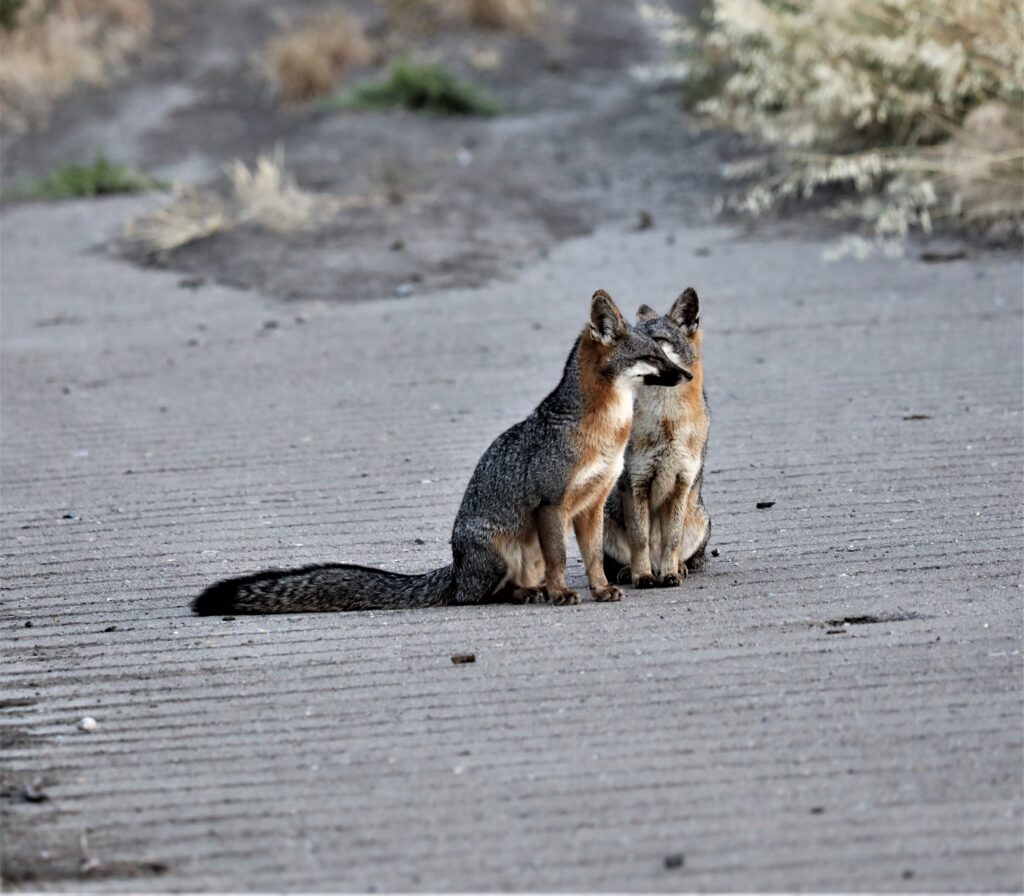
When the two gray foxes Laimos and Big Eyes first discovered the Matadero Creek riparian habitat, and found that no other foxes inhabited the region, immediately, they went to work claiming their territory by intentionally defecating in the middle of Pond Road and in the 1,000-foot-long concrete overflow channel. How far out into the riparian habitat they marked, I could not tell, but within several days I guessed that they had established their territorial boundaries. By using their scat like that, they are sending information, messages to everyone in the riparian habitat nearby and even to me. 

An illustration of that came one morning about two weeks from the time that Laimos and Big Eyes had “completed” their marking territory. I went about my usual morning rounds collecting SD cards from our array of twelve trail cameras situated on the south side of Matadero Creek. I came up on the first camera and noticed fresh scat at the base of the camera post. I didn’t pay too much attention to it, noted that item on my note pad, and continued. I came to the second camera situated on a camera mount on the trunk of a tree. Below it was fresh scat. On and on I went to all twelve cameras and at seven of these cameras, the foxes had marked every one of them. By the time that I finished that morning it was clear that I was being told, in no uncertain fox terms, to pack my bags and cameras and get the hell out of their territory. 

So, when your dog is sniffing along, he is using that odor to identify the dog(s) that put it there. For your dog, there’s recognition along with questions. You dog may sniff by the sprinkler head, and think, “Hey, I know him.” And later, “That one? There’s a new dog on the block. He was here this morning. It’s a female.” “What is she eating? Is she healthy or feeling a bit sick?” Important social information is contained in the odor of both the scat and the urine.

In our next Gray Fox Report, we will explore this question of scat even further. For instance, what are scat wars? How do gray foxes use urine and scent marking areas of mountain lions? Why do they select urine marking versus feces marking? How does it relate to gray foxes from the outside, trespassing on already claimed territory? Just a few of many. 

Until then….

What's Happening at UWRP?

 The podcast can be accessed on any of the podcast “stations” online such as Apple, Spotify iHeart, Podbay, or here at her website https://www.alieward.com/ologies/urocynology. If you chose the website, scroll down the page to find out more. In the very beginning there is a short advertisement before she and I get into the fray of it all. Enjoy. 

If you thought it worthwhile, please, spread the word through your personal networks.


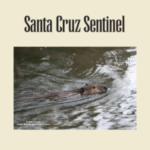
Read the latest about Bill in this new article posted on Palo Alto Online: Experts push for creek naturalization after rare beaver died in Palo Alto https://www.paloaltoonline.com/environment/2025/08/15/experts-push-for-creek-naturalization-after-rare-beaver-died-in-palo-alto/ 

If you or your organization would like to have Bill aka the Fox Guy present one of his four PowerPoint presentations:

1. A Year with the Urban Gray Fox – MOST POPULAR

2. Human Development, Sixth Mass Extinction & Gray Foxes – An historical look at how we got to our present place in history.

3. Gray Fox Cognition – What & How Gray Foxes Perceive – This is a speculative attempt to get inside the mind of a gray fox

4. Corridors & Connections – Sustaining the Health of Our Wildlife – The title says it all

Contact us here https://urbanwildliferesearchproject.org/contact/ and let us know that you would like to have the Fox Guy give a presentation to your organization, corporation, or a home visit.

On June 14, Bill gave a short presentation in the Elephant Room at Safari West, at 8:00 PM. We had a full house and, in the Q, & A segment several interesting questions were asked including, “In the community of gray foxes, do you think there are any LGBTQ foxes?” I replied, “Yes. Science has shown that there are such individuals in many mammal communities. In the fox community, there are some that never pair up with a mate of the opposite sex.”  

Videos and Documentaries

My journey to the University of Zurich, Switzerland, Triggered By Motion

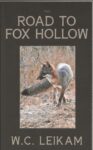
Bill’s book The Road to Fox Hollow can be purchased directly from Bill for a mere $20.00. Just email him through the Contact form on the Urban Wildlife Research Project’s website, leave your email address and he will get back to you. Or you can contact the publisher Di Angelo Publications  .

A video documentary about Bill’s work with the foxes and produced at Stanford University by Syler Peralta-Ramos.

What happens when an opossum and a red fox meet in the night?

In contrast to two other raccoon discipline videos, this one is rather mild.

Gray Fox Playfulness “Hugging” Behaviors.

See the violence of Discipline Raccoon Style.

Screenshot 2025-01-17 alle 11.01.41

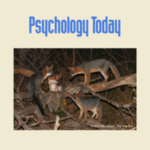
“How to be a Fox” The article about Bill and his ethological approach to his study of the gray fox is online here.   Many are calling this a major article in the wildlife press.

Be Sure to check out our YouTube Channel for some incredible wildlife videos.

Grey Fox General Health

There are no gray foxes in the Palo Alto Baylands Nature Preserve. However, there is a family of three red foxes that have moved into the territory along with a coyote pair. Presently, we are monitoring them.

Gray Fox, Baylands Goals

Within the permit that allows the Urban Wildlife Research Project to conduct its study of the behavior of the gray fox at the Palo Alto Baylands Nature Preserve, the objectives covered are:

  • Monitoring of urban gray fox Denning sites in Palo Alto Baylands.

This is being accomplished during the period when the gray foxes use a den site. It is one of the prime locations for gathering most of the behavioral data of the litter and for adults alike.

  • Assessment of status and population trends of Baylands urban gray foxes.

Since January 2019 a pair of resident gray foxes have claimed territory at the Palo Alto Baylands Nature Preserve.

  • Identification of habitat features that promote the presence of urban gray foxes.

The Urban Wildlife Research Project is working on a project to remove the concrete from Matadero Creek that will create linkages and corridors between the Santa Cruz Mountain Range and the Palo Alto baylands..

  • Assessment of reproductive success and identification of factors that promote successful reproduction.

Open the pinch-point along Matadero Creek by developing thickets that link one area to another, instead of the present island-like habitat.

  • Identification and assessment of possible dispersal travel routes.

Dispersal routes move between the Palo Alto Baylands Nature Preserve and the Shoreline region over in Mountain View. In a north-westerly direction the dispersal corridors run just behind the homes bordering the marshlands in East Palo Alto.

Read more about UWRP in the news:

View and Comment on